


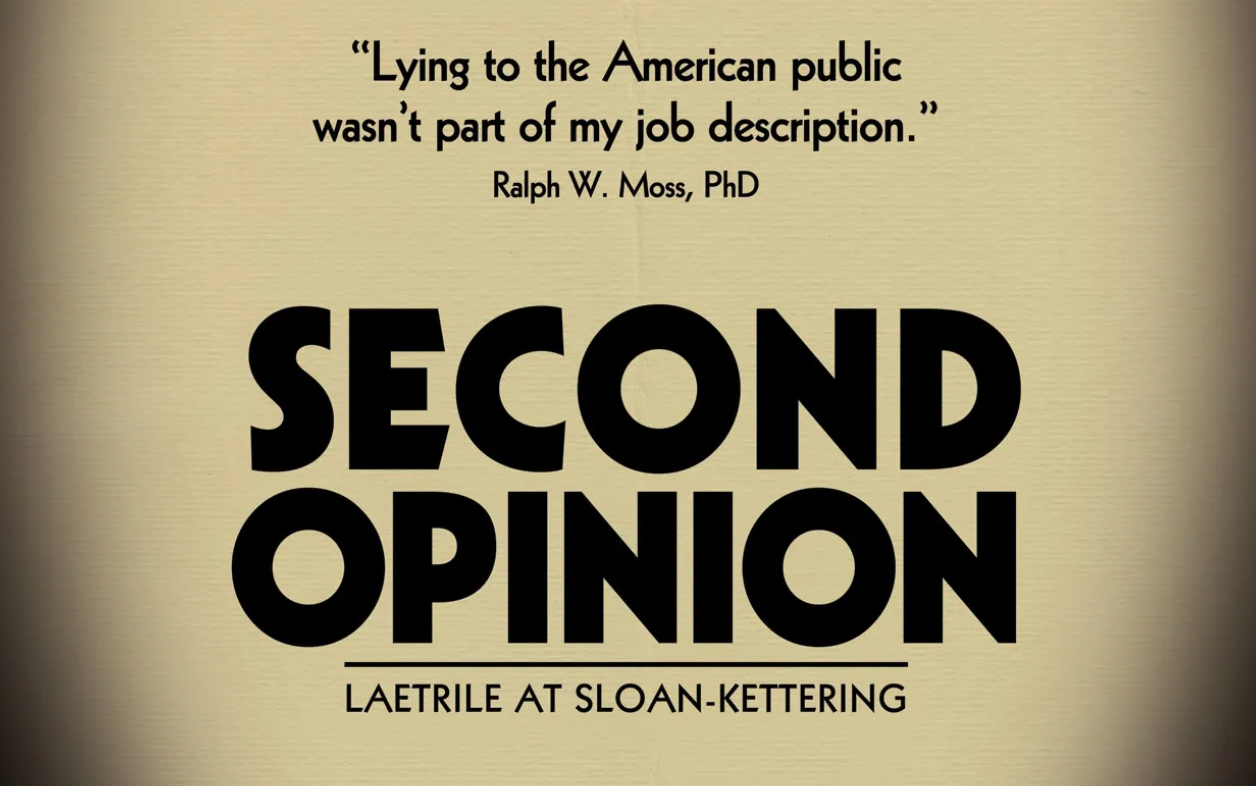
The Film That Disappeared: Second Opinion: Laetrile At Sloan-Kettering
2 minute theatrical trailer
“Ralph W. Moss has stayed the course in stating his case. I am glad his voice is being heard.”
— Harold P. Freeman, MD
Past National President, American Cancer Society
Past Chairman, President’s Cancer Panel
The War on Cancer, launched in the early 1970s, ushered in a wave of new ideas aimed at combating the disease. Memorial Sloan-Kettering Cancer Center — then America’s leading cancer research institution — was tasked with evaluating an unconventional therapy known as Laetrile, in part to address growing public interest in what many labeled a “quack” treatment.
In 1974, Ralph W. Moss, PhD, a young science writer, was hired by Sloan-Kettering’s public relations department to help communicate the institution’s role in the War on Cancer to the American public. One of his first assignments was to write a biography of Dr. Kanematsu Sugiura — one of the center’s most respected and long-standing researchers, and a pioneer in chemotherapy.
While working closely with Sugiura, Moss uncovered something unexpected.
Sugiura had been independently studying Laetrile in laboratory mice — and was observing results that suggested potential therapeutic benefit.
When Moss reported these findings to senior leadership, he was met not with curiosity, but resistance. According to Moss, the institution publicly dismissed Laetrile while internally downplaying or denying the results generated by one of its own leading scientists.
Driven by his respect for Sugiura and concern over what he believed was a suppression of scientific information, Moss made the decision to act.
After exhausting formal channels, he began operating in secret — maintaining his role at Sloan-Kettering while working behind the scenes with a small group of colleagues to anonymously release internal information to the public.
They called their effort: Second Opinion.
The film received strong critical attention — including coverage from The New York Times — and was distributed across major platforms such as Amazon Prime. [All press articles]
However, over time, access to the film became increasingly limited.
Platforms that once carried it no longer made it available, and the original YouTube channel dedicated to the film was removed. Today, the documentary exists only in a restricted form — available through a small number of outlets, including a single YouTube link under a different title and a pay-per-view version on VHX.

Recent Comments